Here and on our website ’t Majeur we tell about our live aboard and the adventures to be as we barge trough Europe.

For a Barge holidays for a few days on board see the web site


Should you want to be notified by email when we have posted a new blog or updated the website, then sent us an email trough
tmajeur@gmail.com, within the subject "follower".

Sunday, 2 August 2015

Samois-sur-Seine to Gray


In the years prior to buying ‘t Majeur we once made the trip from Mulhouse to Dole with other people, we hired a boat on the Nivernais and were part-owners of a boat on which we also cruised the Nivernais.
Since then cruising these regions in middle France were high on our list.
For various reasons we have cruised other parts of France in the last few years, much to our pleasure. Last year we wanted to ‘do’ Burgundy but the broken down bow thruster prevented that.

Moret-sur-Loing
So we were really looking forward to the moment we could go from the Seine into the Canal de Loing and we were more than happy making our first stop in Moret-sur-Loing, it was just what we hoped for (and expected).
After crowded Paris and cruising the Seine it was good to be on the calm canals and especially the small villages.
each time Rebecca helps to turn at least one lockdoor


In many canals locks are automated or you’re provided with a remote control to operate the locks or you have to twist a pole, but here locks are still manually operated.
So, it’s plain politeness to help where possible and, as Michel is on the helm, this task befalls me; it is good exercise and always an opportunity for a chat with the lock keeper who does the other door so it’s improving my French. 

 Before one of the locks we had to wait a long time because it filled on the other side that had to be locked first.
It really took a while and we saw smoke emerging from the lock. We first thought it was a fire, but the photographer on the bridge kept his cool, alternatively taking pictures of what was happening in the lock and then of us.
the man turned from left to right to make pictures
the three smal steamers


The riddle was solved when the doors opened and three very small steamboats emerged. Billowing smoke and hooting they passed us, as interested in us as we were in them.


Although we never visit a church in Holland it’s become a custom of ours to make a tour around the church in French villages – by then you have seen most of the village as well – and to have a peek inside.

What was new after all these years was a bicycle in the church. The lady ministering the flowers wanted to make sure and knowing the Lord sees all, also when they take my bike, the least I can do to help him is by taking it inside.


On our route there are two monuments of interest, Rogny les sept écluses (Rogny of the seven locks) and the pont-canal de Briare, both on the world heritage list.
The seven locks of Rogny date from 4 centuries ago, connecting the Loire and the Seine. Two rivers, flowing in separate valleys, separated by a mountain ridge.

the connection between Seine and Loire where once functioned the lock-staircase

Thanks to this lock-staircase boats could muster a height difference of 25 meters. In 1604 a new design, 7 locks end-to-end with brick walls. It saved on doors (8 instead of 14), the locks could be shorter, the walls lower, so ‘easier’ to build, and the walls interconnecting made it sturdier.
When, in 1608, it was almost finished things took a turn for the worse: wars, vandalism, lack of funds, quarrels and what more so it wasn’t finished till 1635.
The locks worked until 1880, but by then they were too small for the standard boat sizes then in use, they needed too much water – more than available – so they were replaced by 6 locks in a diversion. 

the old lock staircase in Rogny
What remains are the stones - doors and so are long gone - in the middle of the fields as a beacon and symbol of yesteryears boating.


The second monument we were looking ahead to, still in use, was the pont Canal de Briare. Over the past years we have cruised many pont canals, but none as long (662 meters), as beautiful and as well known.
This pont canal – opened in 1896 – connects the banks of the river Loire, an enormous improvement for bargees who until then had to cross on the Loire itself, often dangerous, and – when currents and queues were against you – it could take up to 8 hours, to just to manage an 800 meter stretch from the one lock to the other.

entering the pont-canal de Briare
leaving the pont-canal de Briare
And besides, it is a beautiful structure with pretty lampposts, and Gustave Eiffel was involved, in building the structure under the bridge and the lamposts and pillars on top.


Close to Briare is Gien, although situated on the Loire it is on a non navigable stretch, but within cycling distance.
They sell uncannily expensive earthenware and even in the hall, next to the factory where they sell out-of-date designs and B-choice, prices are staggering.

Rebecca in front of the faïencerie in Gien
Thirty years ago it was less bad and I bought a set of tea cups; we were camping nearby then. I have visited here once or twice again over the years, but it was high on my list to go there again when barging.
We did, prices had gone up again and I restricted myself to replacing two broken teacups.
Not to be repeated, but it can be ticked off.


Cruising these canals you know that you can only go forward, turning is no option and the canals and rivers that you cross are not navigable.
So we knew for sure that we would meet the friends, that were skippering from the southern most point of the canal lateral à la Loire, going North. Neither of us could go elsewhere. So it was no surprise, but surely pleasant to meet before we both went our ways.

ships that meet in the canal
That is one of life’s nicer aspects, sometimes you know you’re going to meet people you know but often it is a coincidence.
But always a good reason for a get together before you’re on your way again and can possibly run into someone you know just around the corner, or meet no-one for weeks.


Past Briare the Canal runs alongside the Loire, sometimes close, sometimes a bit further away. The area between canal and river is a bit marshy, densely grown over and with lots of birds.
here the canal is very close to the river
There are many trees along the canal which was nice as we could do with a bit of shadow, temperatures having risen considerably.
As of the beginning of July there was officially a heat wave, temperatures up to 350C (660F), and luckily on the water it bothers you less, but warm it was and it lasted for three weeks.
 
We were in the middle of the Loire region and here you can see lots of pretty castles and manors, pleasing to the eye, and then, as you turn a corner, you spot the cooling towers of a nuclear power plant, billowing water damp and not really an asset – to the landscape.


little castels along the Loire


the powerplant in Belleville-sur-Loire, not so belle

Shopping has to be done when you can, especially for the heavier stuff it’s nice if the shops are nearby. In this parts it is seldom a problem, there are shops aplenty, we have seen worse. DIY shops though are different, they are meant for visits by cars and preferably on the other side of town. 
a conveniently placed bricollage
A bit bothersome, so if there is a DIY shop next to the canal we happily visit it. And having two spud poles makes mooring easy on a otherwise impossible mooring along a busy road.


In la Charité sur Loire there was but one mooring available, the loading bay of the grain silo which was no problem as there was no barge expected for a few days.


like it used to look
When I came back from a walk it just looked like we were being loaded; that’s how it must have looked like in the olden days when ‘t Majeur, then WUTA, was carrying pebbles between Maasbracht and Mechelen.

As we made a cycling tour near Nevers we spotted – from a vantage point - a nice looking stone pont canal, this one across the river Allier, a tributary of the Loire.
the pont-canal de Guétin seen from af distance

the Allier under the pont-canal

the brave Swiss canoers crossing the pont-canal
As we went across there appeared a canoe behind us with a Swiss couple. They had taken their foldable canoe to here by train, had come down the Allier and now they had schlepped their canoe up to the pont canal; they wanted to go to Nevers via the canal and then to the Loire, all their stuff in the canoe. Quite an enterprise but they loved it.
 

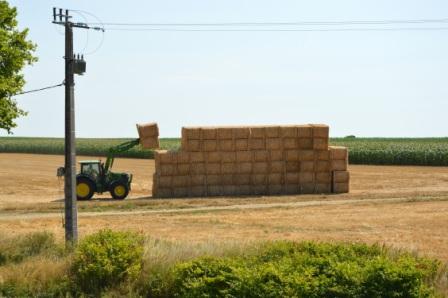
After the Canal latéral à la Loire we continued on the Canal du Centre, with open banks, warmer but with beautiful views. Meanwhile the farmers were eagerly working their land and all bales of hay had to be taken in.
looks like a dincky toy
 Mostly they are those big round bales, but this farmer had square ones and seeing this coupled with seeing the tractor, heaving another bale on top of others, reminded me of how my kid brother used to play with toy cars and little blocks.


It was still very hot, the cows felt it too and you could see them lying under the trees in little groups of on their feet in the canal. This one cow had a pole position and looked for cooling underneath a tree, a one-cow-position and the rest on land.
this cow knew where the best spot was


From the Canal de Centre we moved onto the Saône, a very pretty, broad river. As nice as it had been to go from the Seine onto the canals, we loved going back to the wider waters, doing a bit more than 6 k/h and a real change of scenery.
And, nice mooring positions for to stay a few days.

on the Saône, wide, beautiful and good water for swimming
And here again a pre-arranged meeting with other bargees, who coerced us to go swimming, like they did.
In the canals I had not taken to it but on  these wider waters it was lovely to take a refreshing dip several times a day.
Panache in the Saône


Even Michel and Panache found swimming to be nice when it’s warm.

Meanwhile we cruised as far as Gray and from there – reversing - to Dole. From there it’s back to Gray and then further North, more about which in the next episode.


Wednesday, 3 June 2015

Antoing-Samois sur Seine

And again this year we didn’t make it across the border through the Spiere-Roubaix canal.

After we cruised it in 2012, just after it had been re-opened, there was a different reason each year that prevented it.
It was closed, water-level was too low, lock out-of-order etc. etc.
This time according to the lady in charge we should be able to do it.
Good for us we met a fellow skipper in Antoing who informed us that he had run aground, having a draft of 80 centimetres.
So via Valenciennes it was and for now we’ll stop trying.
We had already decided to take the Canal du Nord to go south, the most commercial and fastest route. Some people dislike the big ships there but they don’t bother us and, once you’re in the flow, you can make good time ‘cause the commercials are in a hurry; it is 19 locks and a 4,5 k tunnel over a total distance of only 95 k. 
The Canal du Nord is okay, but a dry and sunny spell would make it better stil.
In the canal is the Riqueval tunnel, quite a stretch with its 4,5 k, but also spacious and well lit.
Michel wanted to be certain and didn’t want to be bothered by the bimini so he lowered it and – being at it – he set it at its lowest. The two struts at the front then get through their “dead” point, but that causes no problem. We have done that before and if you give them a hand the electric raising thingy gets it all back up again.
The reader will understand our chagrin when we found that the tent could not get up after passing through the tunnel.
The bimini at its lowest position
What and how has happened exactly we still don’t understand but the spindle-arm – that lowers and raises the tent electrically – had come down too low and could not get the tent back up.
The whole of the frame and tarpaulin is so heavy that getting the thing up by hand, up to where the drive could take over, is out of the question.
At first we just were very annoyed but finding a solution is just Michel’s thing …… and yes!


The crane at its highest position, cable run out.
Long line from the cable to the mid-after point of the centre girder
Rebecca on the fore-deck to operate the crane and the camera, Michel on the aft deck and both armed with a walkie talkie.
Slowly winding the cable and raising the tent, to the point where it can be done electrically again
Hooray, everything up and running again, although …… something funny has happened.
We would have understood if the frame had been bent a little, upwards that is, by the force of the crane but to our amazement it was bent downwards, against the pull, how the peep could that happen?
Any takers?
Michel watching the bent frame in upper amazement

On this pic the bent part is clearly visible


 The weather had gotten better so it was a good plan to stay in l’Isle-Adam for a few days, a nice little town on the Oise river, a pleasant stay.

 A bit of work in the garden, lush with all the rain, the violets still blooming, not like other years.


In the winter we received an email from some Frenchman who asked for information on our engine. It led to quite an exchange of mail and Michel has been able to supply information and help him in ordering an engine himself.
Should we ever be near, we had to come and  see him and raft up.
Well, that would be on our route to Paris, on the Seine at Rueil-Malmaison. So we arranged for a stop with Stéphane and his family.
We asked Stéphane if he knew of anyone who might be able to help fixing the frame and he said that maybe he would be that guy.
Michel and Stéphane have bent the frame to its original form.
So now we can use the tent again, but we don’t lower it so far again. We made a provisional stop to prevent it from sagging and the definitive solution is on the winter-to-do-list.
The men working real hard I could try out my latest buy. It’s not really unpleasant to turn a bit and being moved by the wind but I am not really convinced that it is my thing; one of these days I’ll give it another try.

And then to Paris where we stayed for over a week and our son with his girlfriend had the opportunity to discover Paris.
Gotten wise after last years experience with a bike bein’ stolen and noisy nights with people coming on board we came well prepared.
a wooden construction with wheels that roll along the side as the barge moves
During winter Michel had improved on last years solution and together with the ramp it worked wonders. At bedtime we raised the ramp and could get a quiet sleep, great.
 
 We didn’t mind leaving Paris, it is very crowded and full and after three consecutive years of mooring there we’d gotten a bit blasé J.
We did something new this time, we took the dinghy to cruise on the Ourq, a canal that joins Paris to the Marne, but can only be sailed a short stretch.
Really up Panache’s street as for him the dinghy tops everything.

Back from a cruise on the Ourq


We are now starting that part of the journey that we have really been looking forward to, Burgundy.
Via the Canal St. Martin to the Seine and there, at the Chinese, keep right following the Seine instead of left onto the Marne.

That Chinese is a frightfully big restaurant, right at the corner of the junction, a landmark for everyone who cruised there.
At the Chinese, turn right, look at the map.
When you are leaving Paris towards the east you spot along the banks, just like when you are entering via Canal Saint Denis, how people try to build their “home” with tarps, broken caravans and car wrecks, amidst indescribable rubbish.

And then all of a sudden a spot where the inhabitants really have made the effort to make the most of it.
I find it hard to sail past each time, it emphasises the differences in a clear way. And also I wonder if it is all down to bad luck or if it is free will. 
In this region, there being a lot of commercial boating, maintenance on locks and waterways is kept up.
Complete lock systems are renovated like here on the Seine were even the footbridge over the lock is new and a huge mirror is added so you can spot your own ship entering. Art or functional???

After a stop over in Melun, from where we biked to the very impressive Château Vaux le Viconte and adjoining gardens, we are now in Samois-sur-Seine. Just a few weeks early for the annual Django Reinhard festival.
Castle and gardens are seen to be an example for Versailles
Tomorrow we will continue and turn off the river onto the canals. There will be more mooring opportunities there as we are no longer dependent on quays and bollards but can drop our spud legs whenever we spot a nice spot.

More about that in the next blog.

Wednesday, 29 April 2015

Meerkerk-Antoing


Due to the persistent gale, which caused cruising to be out of the question, we stayed in Meerkerk for a week.
One day the winds were so strong that the bridges weren’t operated, queuing commercials not withstanding.

 The light is strange, which brings out a beautiful rainbow

 Crested waves in the Merwede canal at Meerkerk

 Our neighbour, a windmill that drives a water wheel, was doing overtime these days

On leaving Amersfoort we had planned to go back to Holland for a few days, starting April 24th.
In order to do that we have to leave our ship in a save place and we knew just the spot; Antoing in the south of Belgium near Tournai.

Our planning said we would have a 13 day margin, provided we would cruise from 9 to 3 on the other days;  a quiet pace with enough margin to spend a few days moored once in a while.

Now, we’re used to a planning being just that and in real life things are different. This time was no exception.

Before leaving Meerkerk we had gained two days by doing the trip in one day, but we were set back by two days because of the batteries and six because of the bad weather. So, we still had a nice margin but less than we wanted for trips in Belgium.
Last year, on our way back, we sailed right through Den Bosch, which is a nice route for us. It’s not for commercials, too narrow and thus time-consuming and a strain on the town.

March, 2015 saw the opening of the Máxima canal that bypasses Den Bosch for the bigger ships.
We hadn’t realised that that meant no more Den Bosch for us too.
The new canal is not as nice, quite boring in fact; it’s 9 kilometres and counts 8 bridges, must have cost a fortune.

 Máxima canal

We left Den Bosch on Easter day, to find our way to Belgium via the Zuid Willems canal; it would normally take two days because of all the locks but this day we could carry on and all locks were readied for us. The lock keepers were glad for something to do and all day we didn’t view a cruising ship; all moored because of Easter.


The one day gain was lost again next day because, something we had not foreseen, in Belgium everything is closed, and that not only on first but second Easter day as well. So the locks were closed and we had to wait in front of the first Belgium lock.
Just before that we had crossed the border, really not conspicuous if it weren’t for the noticeable difference in maintenance of the water ways and its sides.

 Where Holland becomes Belgium is quite noticeable

After the Bocholt-Herenthals canal we had to cross Antwerp harbour and go by the Royer lock to cross to the tidal Scheldt river in order to get to the Dender river.
Each time we go on the Scheldt  river it takes quite a bit of figuring to decide when is a good time to do so. You have to take the tide into account, as cruising into the current is a waste of time and gasoil, but the duration of the trip is important as well as the tide changes during the ride. Also we have to take into account the moment that the tide changes and so at what time we can leave; 4 o’clock in the morning or at night in the dark are no options for us.
Each day the change of tide shifts by about half an hour. For us this meant – this time – that we had to do the Scheldt before the weekend instead, like we would have preferred, after the weekend because that would have meant cruising in the dark.
 Floating jetty on the Scheldt, meant to go up and down with the tides; doesn’t work all the time apparently

The Northern part of the Dender, a North-South waterway in Belgium, down as far as Aalst is well used by commercials and we could see preparations going on to enlarge the locks and the canalised stretches to facilitate bigger ships.
For us, on the one hand a pity, for it will become less rural and busier, but on the other hand it is good to find, for us too, that navigation increases on these waterways so they will stay open and be well maintained.

Past Aalst it get difficult for bigger ships and we too had to crawl to manage all the bends and the lack of sufficient water under the keel.
Here the Dender and surroundings are lush and green. The locks from Aalst to Blaton – the most Southern point – are hand operated. Both in Belgium and in France this is being done less and less and most locks are (partly) automated.
 Lockkeepers at work


Not just the locks are operated manually but bridges as well, sometimes the bridge keeper acts as a counter weight

We were the first boat to cross past Aalst, and boy, did we find out we were.
All after-winter teething problems were presented to us. Lock doors that didn’t open or close completely and enormous amounts of rubbish collecting at each lock.


At Ninove we had to wait for a day and a half before they managed to open the bridge

After our mishap last year with the broken down bow thruster  we’ve become careful. So, slowly in or out of the lock and trying to shift the bigger detritus aside.
 The rubbish in and around the locks is plentiful

Starting last year we carry a scooter on board, which we like as it enlarges our range compared to cycling.
But, alas, it can just happen that something breaks down just as you’re quite a distance away from the ship, having just been buying things.
Here is Michel pushing the scooter, the accelerator cable snapped, carrying a crate full of groceries at the back looking for a garage or such. I am walking behind carrying two big sacks of toilet paper (which you do need from time to time).
Luckily we found someone who could help us out, temporarily, by cutting the cable so Michel could manually operate it. That is how we got home and by now it has been fixed; so lucky this time.
 Michel doing the heavy work

One striking phenomenon – that has been striking as long as we are cruising – is that lock keepers are on the phone when opening or closing doors.
It makes no difference where or in which country, whether they are young students or older pro’s, they are on the phone all the time at each lock.
Sometimes you are accompanied by a two men crew that comes with you all day, which is necessary if you’re doing ten locks on one day, and at each lock they telephone.
Would it be standing orders?


Lock keepers on the phone

As we came off the Dender we had just a few hours to cruise to Antoing, our destination. We by now had a one day margin left on our original planning, so all right.
At the end of the day we reached the point where we had to do two more locks and half an hours cruising but, as we could spend the night there comfortably, we decided to postpone it till next day.
The lock keeper had switched the lights to green for us, but we informed her, thanking her, on the VHF that we would not go in and would pass the lock next day.
She thanked us for notifying her, whishing us a pleasant day and ‘till next time.

We were really flabbergasted when next day no lights showed on the lock and there was no response on the VHF.
We looked on the net if perhaps we missed another public holiday or some extra information, nothing.
There was one boat moored near us and the skipper told us that all public transport in Belgium was on strike, so the locks were too. They had just picked it up on the radio, not having a clue as to why and for how long.

 All lights at the lock are out

Luckily the strike was over next day and so we arrived in Antoing, having no margin left.
But, as said, it has happened before.
Meanwhile we have returned from Holland, the car has been returned to the hire company and tomorrow we carry on, crossing the border to France about which more in the next blog