Here and on our website ’t Majeur we tell about our live aboard and the adventures to be as we barge trough Europe.

For a Barge holidays for a few days on board see the web site


Should you want to be notified by email when we have posted a new blog or updated the website, then sent us an email trough
tmajeur@gmail.com, within the subject "follower".

Monday, 19 September 2011

Péronne-Maastricht

471,1 KM and 105 locks
We stayed on the Somme as long as possible because we loved it, but in the end we had to come back to Peronne, our starting point.
Although we can set our own agenda and decide each day what we will do, we do have a few social obligations and appointments that cause us to be at a certain location at a certain time.
In this case we had made an arrangement to meet up with fellow DBA-members to meet in Péronne.
August, 12th we took our leave from the Somme, mixed feelings.
Sad because we had a marvellous time and cheerful because of the new experiences that lay ahead. We were not to be disappointed.
This picture shows Rebecca on the Somme, getting a bit of experience; it’s a great river with all its curves and locks to learn to handle the barge and she’s not doing badly at all!
No need to tell me, I can see it all!
We went on the Canal du Nord, heading South as far as Pont l’Eveque. Here we went through a tunnel for the second time, the Tunnel de Panneterie (1,06 km), not as long as the Tunnel de Ruyalcourt (4,5km), but narrower. One floodlight, two torches and one person on each side and all went well. Alas, this was no harbinger for what was to come.
The nice, wide entry to the Tunnel de Panneterie
In Pont l’Eveque we left the Canal du Nord, being out of the way of the bigger commercials (on the Grand Gabarit), dimensions being restricted now to 38,5 m length and 5,05 m width.
On the junction of the Canal du Nord en Canal latéral à l’Oise some 15 or 20 big commercials were moored up, all beflagged; mostly commercial, one of them even sporting an AH flag (AH being a well-known Dutch supermarket).
in spite of them being commercial flags it looked very festive
We queried a skipper and it turned out that they had gathered because one skipper was about to get married, festivities taking up three days! A few days later the ‘just married barge’ overtook us, easily recognisable for all the flowers that had been heaped in the dinghy.

Leaving the Canal latéral à l’Oise we went on to the Canal de l’Oise à l’Aisne, direction South-East, immediately having tp enter a lock.
Over the doors there was a sign saying that the remote control could be had in the cabin on top; after this lock there were no more lockkeepers.

We had to go up and so could only get hold of the remote once we were up.
Apparently we had been spotted by a camera as the doors opened. We went into the chamber and nothing happened, the doors stayed open and we did not rise. So, we backed out, the doors stayed open and we rang each telephone number we could think of querying maps and guidebooks.
In the end we found a cell phone number that got us through to the lockkeeper who was already on his way and got us through the lock.
Apparently we should have been more patient and waited longer. Once up we got our remote that enabled us to operate all locks as far as the Canal des Ardennes.
At a given point you push “up” or “down” and then the lock “knows” which doors to open; inside the chamber you lift a lever, thus telling the lock that you’re ready to be raised or lowered. Very simple and making a lot of keepers redundant. 
Afterwards there was a system where you had to turn a stake, hanging over the water, to activate the lock.
manageable for us to turn the stake but sometimes awkward for smaller craft
The months of June, July and August were dedicated to having guests on board. Each time very pleasant, each time different and luckily the weather was okay or at least better than in Holland.
On the Canal de l’Oise à l’Aisne we had four big boys for visitors, our son and three members of his band. They said it was “awesome” and the weather was perfect, so they went overboard many times a day even jumping from the roof of the pilothouse. 


After the boys had left we passed through tunnel number three on this trip, the Tunnel de Braye en Lannois (2,36km), That did not go unnoticed.
The entrance was wide enough, although the graffiti gave it an unpleasant look
Here everything went wrong and we still don’t know why; Murphy probably.
We thought we would “do” this one, but the canopy had not been set low enough, than a wrong turn in the beginning set off a chain of events making it hard to get the ship on course, there was a towpath (the perfect thing to sidle up to) only on one side, the walls were rocky and uneven, this tunnel was narrower than the previous one, in other words: it went wrong!
The edge of the canopy chafed the rocks (or the other way around) and though we quickly lowered it the damage had been done and the right-hand side had been filed off.
On top of that we lost one of the big fenders up front. Luckily the tunnel keeper permitted Michel to retrieve it, walking back into the tunnel. They are expensive!
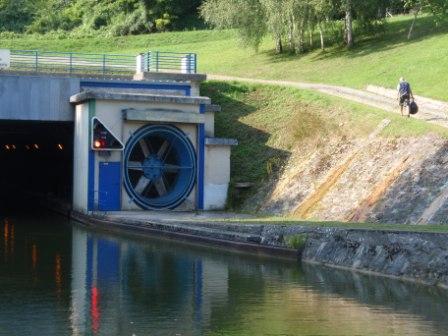
Michel picked up the fender from the tunnel, not a nice walk according to him
By the end of the day we were dead tired but luckily we came to a nice spot, a pontoon just after a lock; very quiet and easy mooring. Just what we needed. As we sat in the twilight, enjoying a glass of wine, a peniche came along that had to moor as well. We offered him to shift and take our lines off, offering him access to at least one bollard, but there was no need for that.
mooring sideways
As there was no more traffic he just moored up across the canal and planned to set off at the earliest opening of the lock. 
Next day Michel repaired the tear with duct tape, which holds so far. It will be a winter repair.
a perfect quay for repairs
In the canals that connect rivers and that run alongside the river you sometimes go through a Pont Canal, crossing the river and each time it’s a special occasion. It makes you realise the enormous amount of work that has been put into digging and constructing the canals, now long ago.

The Pont de Canal crossing the Oise
After the canal connecting the Oise and the Aisne we – logically - entered the Canal latéral à l’Aisne.
It was a special occasion for us as we came across an important place from our past, the lock at Berry au Bac.
Bridge and lock at Berry au Bac
Here the road via Reims to the Netherlands crosses the canal, there is a picnic table at the lock and to us it had been a stopover on our way back home after many a holiday where we had been sitting, looking longingly at the barges, thinking that one day …..

The Canal latéral à l’Aisne suddenly is called the Canal des Ardennes,which ends in the Meuse river. This last canal is really beautiful, very green, not too wide, lots of trees lining the banks alternating with nice meadows, offering beautiful vistas. Completely different from the Somme, where everything is more flat.
One of the many beautiful spots along the bank
morning mist on the water

 
Although still in August, mornings are misty and the sun 
has to work, but after that it gets warm quickly and the 
skipper sits in the sun, handling the barge.


At evening we notice it’s getting towards the end of the year, dusk comes quicker and there are beautiful skies, giving you with views over the stilled water.
locks mirrored in the stilled water
After the Tunnel de Bray we went down, but from Berry-au-Bac you have to get up in order to reach the Tunnel de St. Aignan, that being the summit where you reach the Meuse at Pont-a-Bar; from there it’s going down all the way.
2 locks of the 27-stretch; the curves prevent you from seeing more than two at the time
Over a stretch of some 125 kilometres, passing 45 locks we had risen about a 100 meters. 27 Locks are situated close to one another, like a staircase, stretching only 10 kilometres from Semuy to Le Chesne and getting you up some 80 meters. It’s entering and leaving locks all day long.
In some locks we were surrounded by greenery, giving testimony of the sparse use of the Canal des Ardennes
a regular garden all on the sides of the lock
On the canal we ran into a sailing boat, no mast. Those who think that we are cramped for space, take a good look at this picture. 
The ship, 12 metres, belongs to a couple that has been living on it for 9 years already. They crossed the Atlantic from the States, have been all over Europe and now they were doing the French canals, starting from the South in order to winterise in Paris. They will have their mast sent over.
 
Once up we came to the next tunnel, a relief after Braye; plenty of space, only 200 metres, in and out before you know it and a beautiful picture to top it off.

Tunnel de St. Aignan
And then there was the river Meuse, quite a change after months of canals, now on a river, broad and an actual current.
a broad view after the canals
The Meuse is beautiful to sail, there being very few – none actually – commercials until you reach Givet.
Next year we plan to sail the stretch from Verdun to Sedan, southerly from where we entered the Meuse.  
The landscape is either green or rocky and in between picturesque villages and beautiful houses. Because of the railway running alongside the Meuse it’s remarkably like the Märklin toy-railway.

We’re now at the end of August, autumn is colouring the view; pity summer is almost over but a beautiful sight.
 The rocky sides are very popular with mountaineers, looking like little spiders attached to the cliff. Not my cup of tea, but I can imagine that you get a kick out of reaching the peak.
two climbers marked in the arrow and circle
here they are, all of their own volition – I presume
After a very nice journey we came to the point where we had to make preparations for getting through the Ham Tunnel at Givet.
The tunnel of Braye en Lannois being a summit, crossing the watershed between two rivers (the Oise and the Aisne), the Ham Tunnel is a shortcut, avoiding a big loop in the Meuse.
On approach you can immediately spot the difference with the other tunnels
This tunnel (600 metres) has a bad reputation because of the narrow dimensions, both height and width, there are no lights, the walls are very uneven, pieces of rock sticking out and no towpath either way.
Our disadvantage is the sunroof being the width of the ship. We can lower it, but not narrow it. Because of our previous experiences we were determined to go in well prepared.
Canopy down all the way and the canvas pulled back so Michel could pilot upright
al fresco piloting

Fenders along the railing and extra protection on the corners of the frame of the canopy, Be Prepared!
At the lock just before tunnel the lockkeeper looked at us, showed us some mercy and said: no problem, I’ll just lower the water level a bit, and by the way, the dimensions shown in the map are not correct, there is more headroom!
We felt a bit let-down.
here you can see there was little margin between the frame and the sides of the tunnel, and that on both sides
All together these measures were not superfluous because we fitted inside only just. Very slowly we went, no damage done, pffffffffffffff!

From Givet to Namur there was more traffic, big commercials and industrial sites along the banks.
Namur is a nice town where we found ourselves a nice spot along the quay.

Michel was a bit puzzled when he (I was off to Amsterdam for a few days) suddenly found a raft on the rudder.
As it turned out it was a raft from the boy scouts, gone adrift. Part of it ended between the doors of the lock, causing some damage and the other part floated down the barrage, ending up on our rudder, no damage there luckily.
The planks were tied to old drums, some leaky and filled with water, far to heavy for our little crane; a proper crane on a truck had to get it out
arrow pointing at ‘t Majeur
From the Citadel of Namur, a very impressive site of walls and buildings, though most of it dilapidated, there is a splendid view on the Meuse valley were there was a very tiny 't Majeur
steam rising from the chimneys at Huy
After Namur rural is done, quays mainly and lots of industrial areas and big factories, although looking back at the nuclear plant at Huy – there are more of them along the Meuse - makes a very impressive sight.

We passed by Liege (Luik), for now, because we wanted to get to Maastricht in time, it being Michels turn now to go to Amsterdam for a few days. Next time I certainly would like to moor in Liege, on a Sunday, because there is a very nice and big market there on a 2 kilometre stretch from the quay to the centre, lovely!
There’s more towns and villages on the Meuse that we sailed past but that we will visit someday. You just cannot do it all at once and we still have a few years ahead of us, just as well.
When getting to Liege we had a moment of tension – no photo’s, alas.
We came upon a lock, having announced our arrival already to the lockkeeper who told us we had to wait a bit before entering. Michel revved down and then the engine stalled. Very annoying going downstream, windy weather and a big commercial right behind you.
Fortunately there was a proper quay and we turned the ship towards it, floating on the current whilst radioing the commercial that we were in trouble; he immediately offered assistance when needed and we just hoped for the best.
All went well, the commercial could get around us and a small yacht, that sailed behind the commercial, pushed us towards the quay, covering the last few metres, worth a picture.
After that we did our Holmes & Watson act and by reason and deduction concluded that it had to be due to lack of gasoline, caused by suddenly revving down. Shouldn’t happen, but there you are.
After half an hour the engine started right away, so far so good.
Something else to add to our list of experience.
Here follows a kind of cartoon about a big barge next to us in the lock, being inattentive whilst going down and they couldn’t get their rope off the bollard. The water level dropped over 13 metres and as they were testily trying to get the rope down the barge went down even faster leaving the bollard up there.
trying to get the rope off from the ships deck
the skipper climbing up with a boathook.
not even from the quay can he get the rope off the bollard
no other solution than to cut the rope
the sad result
Meanwhile we have reached the Netherlands and we have been in Maastricht for a few days already. From here we go along the Zuid-Willemsvaart to ‘s Hertogenbosch, thereafter to Dordrecht and finally to Haarlem where it’s time for a stop and to spend winter.
I will write just one more entry in this blog, covering the last leg and next year there will be a new tale of our travels.
PS. The update on the garden
The tomatoes were great, so was the lettuce but the broccoli and the cabbage were no great success. Next year more herbs and flowers; it’s fun to have a garden onboard and to hear all the comments from the land-lubbers.


Friday, 5 August 2011

Pommeroeul – Courtray – Menen - Courtray & Courtray-Spierre-Astene-Lille & Lille-Douai-Péronne-Somme


The last entry in my Dutch blog has not been done in English. There was little of interest to tell, but now here is an update.
From Pommeroeul we went to Courtray by way of the Bossuit Canal. We spent a night at the Bossuit end, next to big pumps that get oxygen into the water, which is pumped out of the Scheldt river and contains too little of it for the fish in the canal. We slept like roses, no coincidence I’m sure.
oxygen pumps in the water
In Courtray we could leave the ship for a few days so we could go to Holland for a few anniversaries and such like and we came back by car to find out if having it nearby would be handy.
From Courtray we sailed to Menen, about a hour and a halve cruising, where we stayed for a fortnight.
Michel did a lot of maintenance on the main engine, we did some shopping with the car and Michel watched tennis at Roland Garros, time well spent. Unfortunately we discovered that our woodworm was still active. Our bathroom sink (that is, the wood underneath) was full of little holes.
We had a man from Rentokill aboard who told us that it was not woodworm but an different kind of beetle that loves multilayered wood and mostly stays in one layer, eating it away completely. So there is no way of knowing how much of this wood is still there, or isn’t.
The only real solution is to scrape the paint of all wood (absolutely impossible) and hire an official exterminator – costing a lot of money and even then.
This we considered not be an option so we treated as much of the contaminated wood that we could get at ourselves after removing the paint; time well spent but no fun.
When we were to make to return trip to Courtray, in order to go to Holland once more, we were a bit delayed as the canal was blocked because of a body floating in the river; brrrr I am just happy it wasn’t us who discovered it.
Courtray-Spierre-Astene-Lille
one trip going round and the other up and down
It’s been quite awhile since my last entry, so I will split this one; otherwise the map will be incomprehensible.
Life aboard seems to be quiet and at a slow pace, but time really flies and we’re always busy so updating this blog often comes last.
using a hotspot where it's to be found
And getting an entry uploaded is more complicated than at home. Email onboard is fairly easy, but for Skype or an upload you need a hotspot. Not always easy to find and when found you sometimes have to be on the street with your laptop.
Off course we are running a household with al standard chores such as washing, cleaning, shopping in short all the things we don’t do when barging.
And then there is getting to know the new whereabouts, cycling and walking.
Shopping for instance takes up more time and planning if only because it has to be done when shops are available, nearby or in a neighbouring village.
Shopping is done by bike, so it takes getting the bike on land, together with the trolley and afterwards getting them onboard again, sometimes by hand, sometimes with our little crane.

You cannot always moor right up against the quay because its too shallow and then we have to get the gangway in place which takes a bit of palaver and hoisting and in any case lots of time. Every day we are barging you have to get the ship ready to go and afterwards to moor.
Regularly we – that is Michel, really – have to fill the water tanks, clean the filters (for the cooling water) check the oil and batteries and all sorts of clutter.
What does take up time too is chatting: all the people we meet in locks, near moorings or if they come up to ask questions; very good for our French and very entertaining.
And then all the locks we have to get through. Any given lock takes three quarters of an hour to pass (on the average). So, at the end of a days barging, we’re tired and have just enough energy left to cook, to rig the satellite dish, watch the telly or read a bit.
We’re going to bed earlier than we used to. And, everything we do is done at a slower pace, something we cherish.

Lots has happened since the last entry in this blog and we have come a long way. We have gone back to Holland twice and gone to France by car. That’s something we will do differently next year. Getting to and fro is disquieting and having the car nearby whilst barging is not really a bonus, because having it nearby means collecting it every few days by bike.
how could this happen???
When we returned from Holland on June, 16th we found the ship in a fine condition moored to the pontoon, this time no ado with the pumps. But– to our amazement -  we found that one of the spud poles, firmly embedded, had turned twice along its axis getting a knot in the steel cable. It is still an enigma how this could happen.
the rural Belgian Canal de l'Espierre
Next day we sailed the Bossuit Canal again, this time heading for Spierre.
The Canal de l’Espierre – Roubaix is a link between Belgium and France, a passage for commercials that has not been navigable and closed of for the last thirty years.
the more urban French Canal de Roubaix
The Belgian stretch is very rural, in France it takes you right through the town of Roubaix.
Working together on both sides, the canal now has been reopened for pleasure craft only.
the entrance, we heard they now did something about the walls
That is where the cooperation stops, any communication between the two is nonexistent, which makes it a bit puzzling. It’s all a bit new, we were the first sizable barge to get through the entire length of the canal, there was uncertainty about opening times or where to get that information, but in all it was very amusing.
 The Spierre entrance – a lock no longer in use – had a width of 5.10M, in theory, but we could only get through at a snails pace and even then we pried stones loose from the quay. Thirty years of non use takes it’s toll apparently. ‘t Majeur has a width of 4,58M so any barge broader than that has a problem. We pointed this out to the responsible people and they would look into it.
it made us feel 'royal' all those people waving and cheering
We found a few more teething problems that had not been detected when smaller boats went through which made it all good fun.
During the trip, and the more so in Roubaix, people came out to wave at us because they were happy to see ships passing again, an almost royal experience.
Musée de Piscine in Roubaix
In Roubaix we went to visit de Musée de Piscine, formerly a swimming pool that has been converted into a museum, retaining the look and feel of a swimming pool (the water, dressing rooms etc.), beautiful glass stained windows and worth a visit.
In the canal we also passed under an very interesting bridge, that is to say, two lifting bridges about 25M apart, getting up in unison. They are part of a roundabout, the canal goes right “through” it, so to speak.
both bridges lifted
't Majeur in the middle of the roundabout
It takes four bridge keepers to handle the traffic because no one is used to those bridges being open.
At the first lock we happened to talk with a couple that strolled by. They were looking at our ship and when we came trough the next lock they were there as well. We picked up where we left the conversation, now in the pub at the lock, enjoying the local Satcheu-beer (the satcheu is the man, or woman, who towed a barge in the olden days.
One of the strollers – the man – runs a small pub plus museum in the so called Sashuis (lockkeepers house) in Astene, nearby Ghent on the Leie river. The lock is redundant but the lifting bridge is still operated by hand.
The following weekend there would be a Sas-festival, there would be a few beflagged barges and we were asked to join, exposing ‘t Majeur and because it would be fun.
And indeed, when we came out of the Roubaix canal, we did not turn left Southwards but went right, up North going into Belgian territory again.
En route, waiting before the St Baafsvijve lock, the out-coming barge cast us aside (by its bow wave) effectively stranding us on the sloping bank of the canal. Using VHF we informed the lockkeeper that we were unable to move and the huge barge behind us immediately offered assistance.
the closer they get, the bigger they look
The wash of their bow thruster however proved to be sufficient to lift us and set us free, case closed.
the bridge and the quais of the unused lock
the dead Leie branch makes a beautiful bit of nature
It was a long day, but we finally arrived at one of our most idyllic moorings ever.
We went back to Courtray to collect our own car and then went on to visit France in order to open a banking account. That took us, after the preliminary introduction by a friend of ours already done, almost two hours and 100 signatures.
Later that week Rebecca went back to visit Holland and we opened – on the spur of the moment – an account in Belgium (just walk in, 15 minutes work, 2 signatures and we could even use our own home address).
Thereafter we partook in the Sas festival and all the drinking and socializing that come with it.


beautiful weatherlots and lots of people having fun

the beflagged ships behind the lock quai
After a very nice and relaxing fortnight, we decided to go south after all. Again via Courtray and Menen (fourth time in all) until at Lille we entered new territory al last.
Lille-Douai-Péronne-Somme

Just south of Lille we crossed – underneath – the A1, known to everyone that travels that highway by its colourful bridges. This is what it looks like underneath
going under the A1
In Douai we managed eventually to get an internet subscription, thanks to our French account. We decided to forgo a pay-as-you-go SIM-card when we found out that using our own Dutch subscription – in France! -  is cheaper than the French prepaid.
Unfortunately  I dropped my cell phone containing the Dutch SIM in the canal – no amount of dredging got it back -  and Michel’s cell plus SIM couldn’t be found. So all we then had was 2 Belgian SIM’s with very low credit and no opportunity to buy a French one, not the most practical of situations!
Lucky for us a week afterwards we got visitors from Holland, that brought us the replacement SIM’s.
From Douai we went on to Arleux, Capital of Garlic, so we now have a nice string of garlic hanging on the aft deck. At Arleux we entered  the Canal du Nord.
On the Canal du Nord all locks are 91M in length and 5,95 wide, so the really big commercials can not get there which makes navigating a bit more relaxing and enjoyable.
Going down that canal up to Péronne where we wanted to enter the Somme meant getting through six locks – rising 6m apiece – at the summit going through a 4,5Km tunnel and then another 5 locks going down 6M at each.
the screens to watch the tunnel, 't Majeur you can see moored near the entrance on the middle screen left
The Tunnel de Ruyaulcourt was our first and quite an experience. Traffic is regulated with lights and there is a “lock” keeper with an array of screens, overlooking it all. We were allowed to visit there, very impressive.
the entrance to the tunnel
halfway in the tunnel
First there is 1,5Km stretch that is one-way, than a 1,5Km two-way and another 1,5Km one-way stretch. When the lights are green you may enter the tunnel until the red-light at the end of the first part, then you may enter the middle part, not too much width there so crawling is advised, and all that in semi darkness. There are lights but we were relieved to get to the end.
At the last lock before Péronne we were told that a barge with a draught of 1,4M had entered the Somme the day before, so that was our green light, expecting no problems with our 1,2M draught.
After a stop in Péronne to do some shopping we finally entered the Somme on July, 9th ; an occasion we had been looking forward to that had been uncertain until the last moment, so a memorable event!

We have been sailing the Somme for some three weeks now and we are halfway the return trip. We went up to Abbeville an turned there; we skipped the last leg to the Atlantic because of expected mooring problems.
beautiful mooring places with trees to hang the hammock
and again nice scenery around the bend
This is a terrific region, the weather is fair to beautiful, around each bend (lots and lots) is again a beautiful scenery. Sometimes we look at each other, stifling a yawn because it a bit monotonous. Cute villages, nice – palatial – homes, beautiful nature, lots of flowers, birds and animals, clear water and very few barges.
it really was a test for the crane, 300 kilo, but it worked fine
On and off we have friends or relatives barging along, which is very enjoyable. One of them had a bike that we hoisted onboard and took with us.

There was this spot where we had arranged to meet friends and there was moored up a small tug used for maintenance. It was the clearest indication of telling our friends where to meet us, better than a self built signpost.
we made it, with the sunroof intact
Most of the Somme bridges are fixed, but with enough clearance and on a few occasions we had to lower the canopy in order to get through. There was this one bridge where margins were really thin.
the lady watches all traffic
And then, luckily, you come across a golden blessed Virgin, baby on her arms, watching over the few boats getting under the bridge and the even fewer cars going over, should be helpful anyway
And even Panache lives like a king. He seldom has to be on a leash, only when in urban areas, and he has most of the “halage” (the towpath) to himself. He will really have to re-adjust when he’s back in Haarlem.
Panache strolls along